
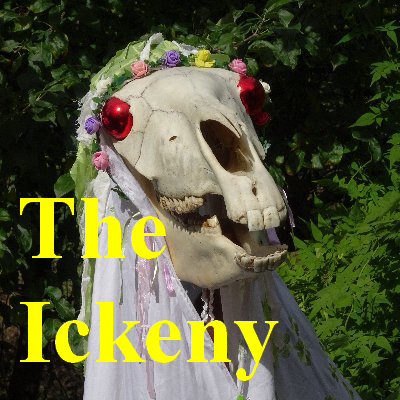
Norwich Pagan Moot is a gathering of Pagans and others who acknowledge the spirit in the Earth and Sky, Land and Sea. We hold two regular in-person gatherings a month - the second Sunday evening talk or workshop and the fourth Saturday Coffee Moot. We are also starting up the on-line presentations again! See the 'Events' page for more information. In October, we have our annual Boudica's Brocante. We also have a number of public rituals and walks through the year, notably the annual Twelfth Night ritual on Mousehold Heath. Our 'oss, the Ickeny, usually makes an appearance at rituals, especially Twelfth Night! We are a friendly, welcoming and supportive organisation and do not discriminate on grounds of belief, gender, disability, race or sexuality. Our events are public and open to all. Find out more on the 'Events' page and in our Facebook group. Scroll down for our full contact details.
Our new logo, with a Green Man / foliate head, is by the fabulous Vix Valentine: to whom we are very grateful!



Older news is archived here.
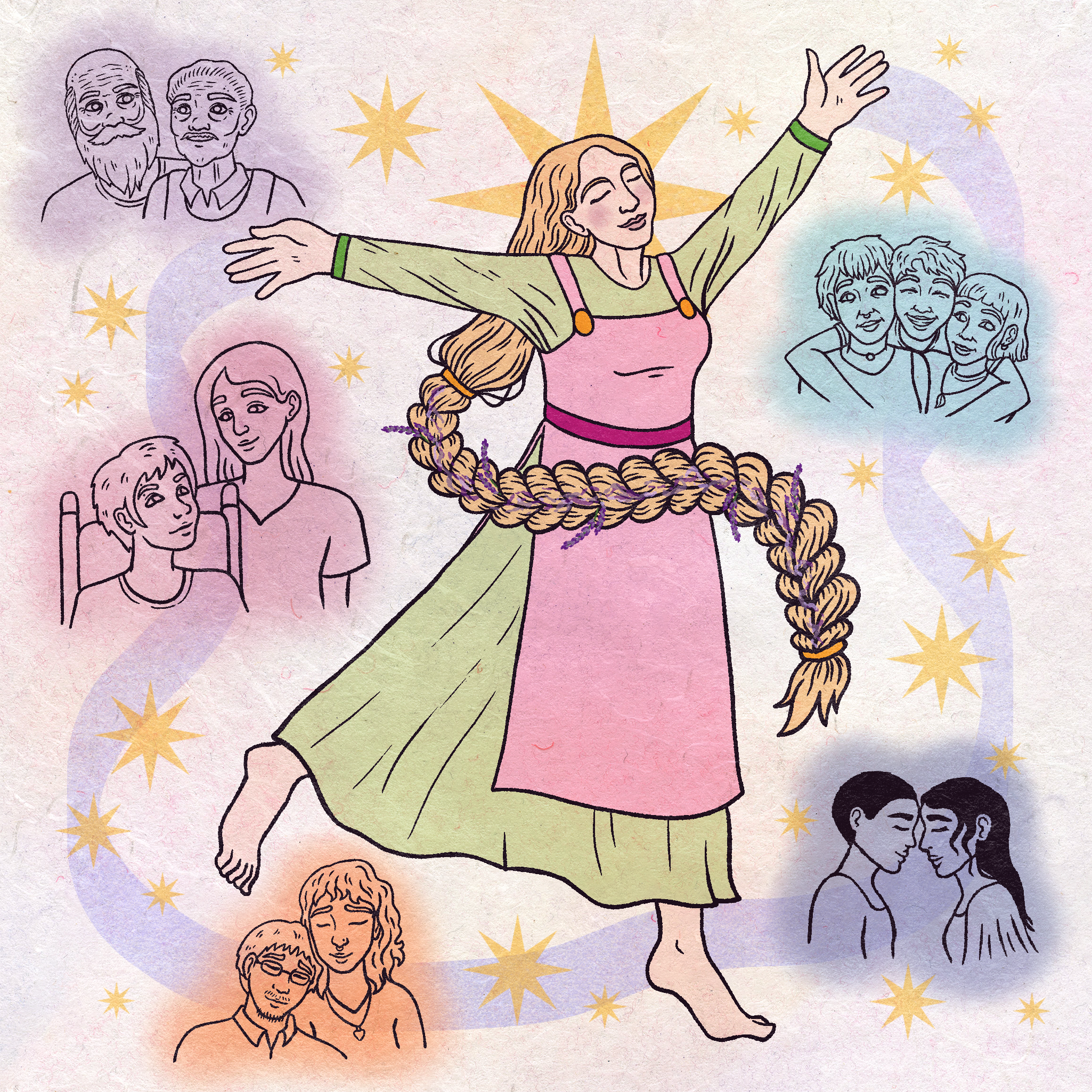
Lofn by Vix Valentine
Val Thomas writes…
Our goddess this week is Lofn, who is a guardian of forbidden unions. In the Gylfaginning, in Snorri Sturluson’s Prose Edda (Anthony Faulkes translation), we are told of Lofn:
She is so kind and good to pray to that she gets leave from All-father or Frigg for people’s union, between men and women, even if before it was hidden or refused. Hence it is from her name that it is called lof [permission] as well as when something is praised (lofat) greatly by people.
This is the extent of the source material we have about Lofn who clearly has considerable powers to remove obstacles to love relationships. These could include a discrepancy in rank between couples, a problem of family affiliations or difficulties raising the necessary funds for the groom to pay the bride’s family for the loss of a valuable family member. According to Alice Karlsdóttír, in Norse Goddess Magic, the sealing of a marriage bargain was a complex matter with exchanges of gifts at its heart: plenty of scope, perhaps, for obstacles to arise. Karlsdóttir points out that it is often older generations which put obstacles in the way of young lovers, so Lofn is often visualised as a youthful goddess, a revolutionary defying authority to support individual freedom. Nevertheless she may assist lovers of any age and gender who wish to be together, although this is only where the feelings are mutual. She will not help someone to attract love where it does not already exist.
In more recent times, Lofn has come to be regarded as a champion of oppressed lovers of all kinds. According to Rev. Máire Durkan, in Frigg’s Twelvefold Flame:
Lofn sanctifies unions seen as unholy by colonialism, white supremacy and cishetero-patriarchy, including queer love, interracial relationships, polyamorous families and relationships that challenge respectability politics.
Thus she can be invoked by LGBTQIA+ and BIPOC communities, as Durkan sees her as gentle to those who request her help but fierce against enemies as she champions justice and supports loving, mutual relationships between consenting adults, even when they are disapproved of by society or against the law. She can see when love is genuine but does not lend her support to harmful, self-destructive or abusive relationships. In this respect, Alice Kerridge-Crick has explained to me that, in her experience, Lofn’s answer isn’t always ‘yes’ and that she may bring about the end of doomed romances or even floundering friendships if they are no longer right for the people involved. The final ending often comes at Lofn’s special time of year in late February or early March.
Durkan makes the interesting point that, in Icelandic, lavender is called lofnarblóm, so it is Lofn’s special herb, which has long been associated with LGBTQIA+ identity.
Durkan ascribes a whole list of runes to Lofn but the first two on that list seem particularly appropriate: Naudhiz for need, resilience and advocating for liberation and Tiwaz for justice and the balancing of the dynamics of power.
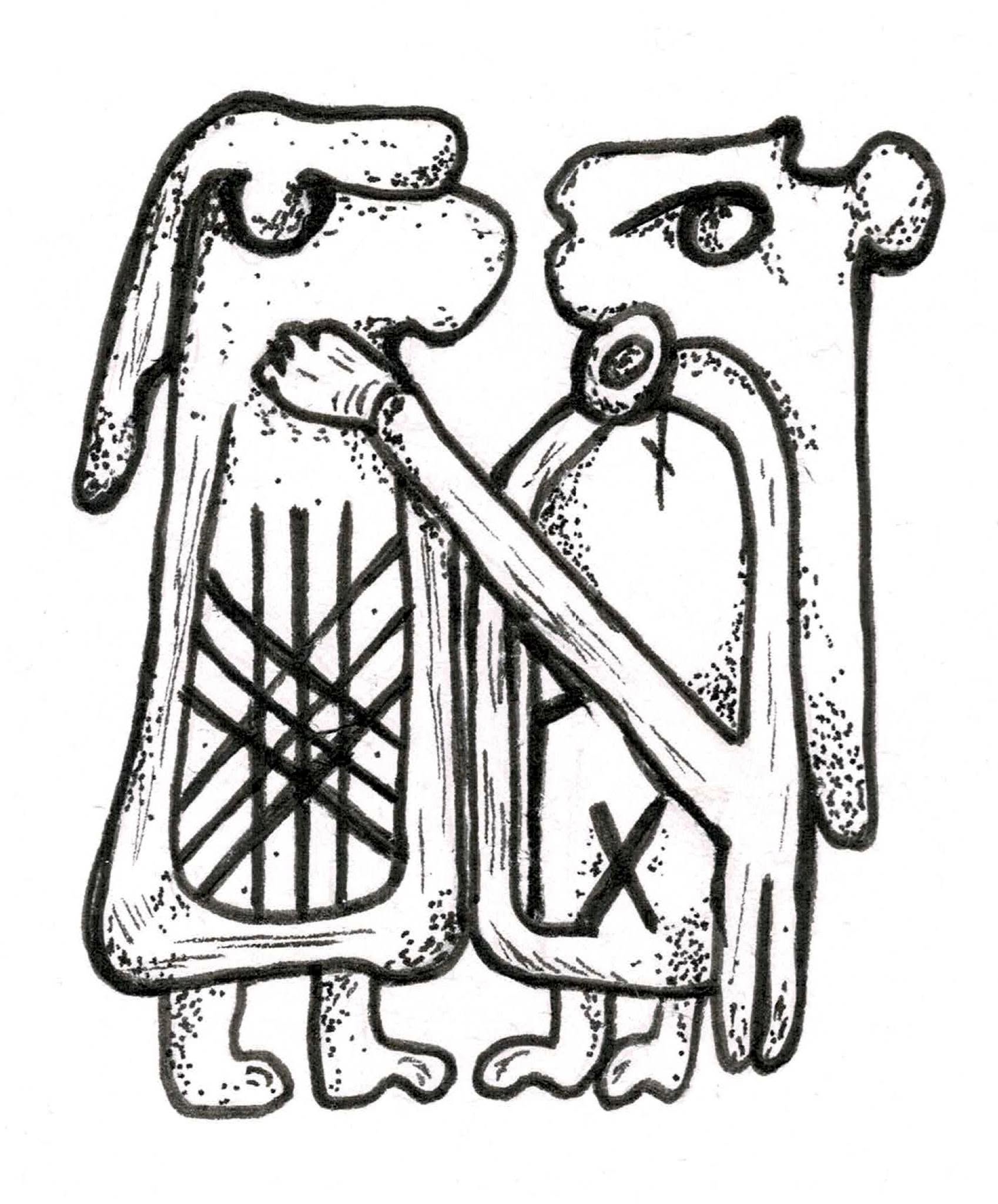
Sjöfn by Alice Kerridge-Crick
Val Thomas writes…
Our sixth goddess for Twelfth Night, Sjöfn, is a shadowy figure as the source material provides so little about her. In Snorri Sturluson’s Prose Edda (as translated by Anthony Faulkes) we are told in the Gylfaginning:
She is much concerned to direct people’s minds to love, both women and men. It is from her name that affection is called ‘siafni’.
Other than that, and the naming of her in Skáldskaparmá as one of the Ásynjur, we have no textual information about her. However, many commentators agree that she is not a simple love goddess, but that, as Alice Karlsdóttír, in Norse Goddess Magic (p. 154) states, she reconciles quarrelling spouses and keeps harmony and peace amongst people in general. The feelings involved go beyond infatuation. Rather, they are those that: "affect a person at the deepest level of being, touching all facets of the soul." This is "real frith that binds people together socially at the deepest level, the love of family, tribe, nation and even the world and life itself." (Frith is an Old English word meaning fruitful peace and joy.) Thus, the runes associated with her include Wunjo and Gifu.
Siöfn has been little spoken of in the Moot context. The only time I can remember any discussion of her was when Alice Kerridge-Crick ran her excellent series of workshops about the Handmaidens of Frigg back in 2023-4. Nevertheless, she has blessed the Moot by weaving frith between us and strengthening the bonds which have held the community together for some four decades. Ever since Eric Winch started it back in the 1980s, Norwich Moot has welcomed people of all ages, social and educational backgrounds and persuasions (from army veterans to pacifists, or vegans to hunters and dedicated carnivores). The range of opinions held by members has been vast but people have been drawn together and for the most part got along in spite of our differences and provided a strong support network. We have worked magically together, mourned and celebrated, got drunk, fought, shouted and thrown literal and metaphorical plates at times! Yet, as in any cantankerous extended family, the bonds between us have stayed strong and a powerful egregore has been created, as we have tolerated and even tried to understand views and attitudes which may seem diametrically opposed to our own. And Sjöfn has been there, not wearing a fancy robe, but moving gently amongst us with the peace weaver’s cup held in both hands.
How will Sjöfn manage in this post-Brexit, post-pandemic social-media-driven world where we are ‘supposed’ to stay in our echo chambers and where tolerance is to be replaced by ‘cancelling’ those we disagree with? Sjöfn’s frith is surely not about passively toeing the party line and never quarrelling, but rather about understanding the bonds which keep us together and allow the kinship group to be greater than the sum of its individual members. Long may Sjöfn work her quiet magic and help our community to thrive.
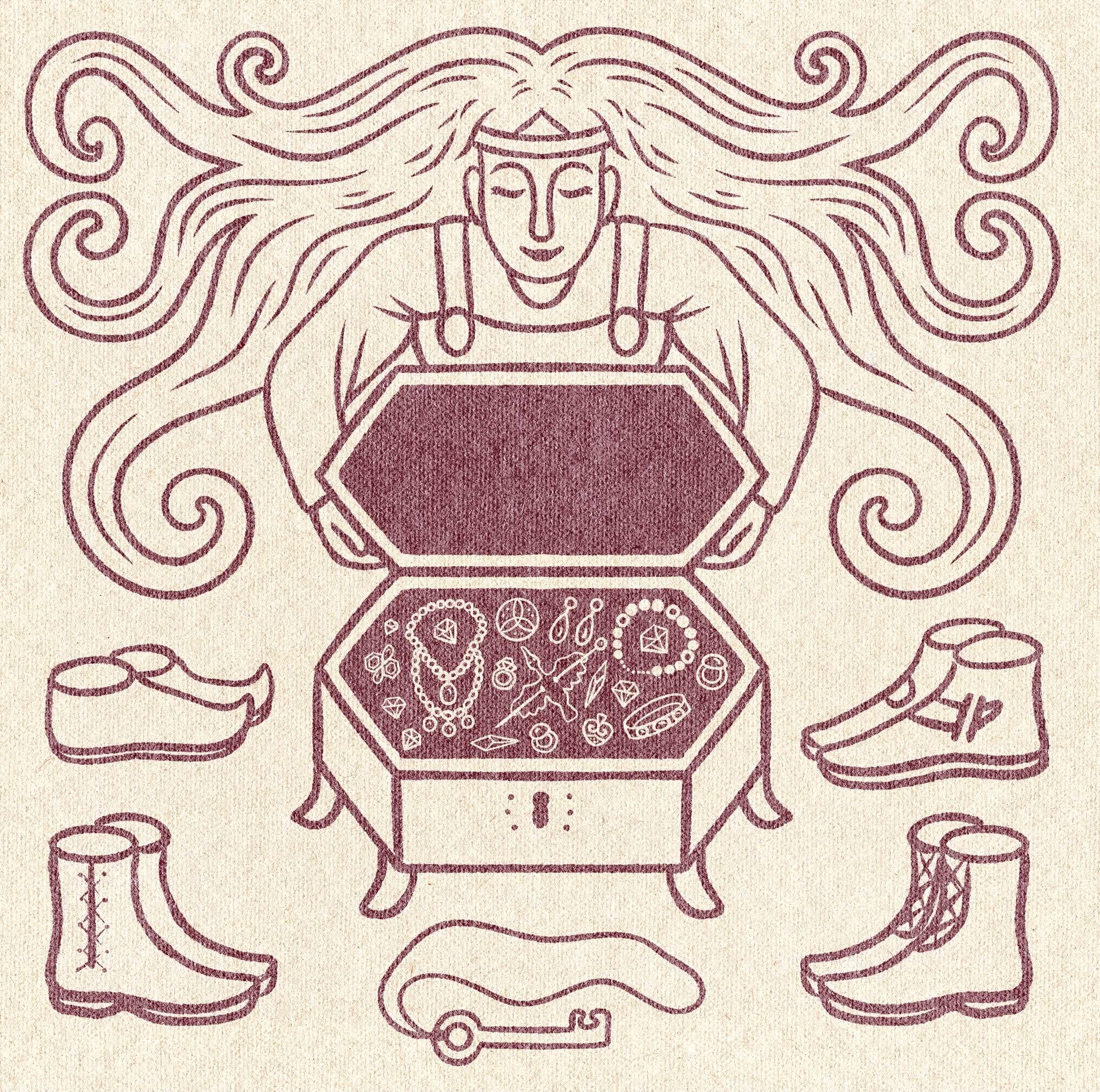
Fulla by Vix Valentine
Val Thomas writes…
In this, the week after Michaelmas, we consider the fifth of our Twelfth Night Goddesses, Fulla, who is Frigg’s closest companion, perhaps best known for carrying her casket of treasures. We could interpret these as literal treasures, such as jewels and other valuable items, or they may represent, as Alice Karlsdóttír suggests, in Norse Goddess Magic, the Divine Mother’s blessings: prosperity and fertility. Fulla takes care of this power until Frigg is ready to dispense it. In the Gylfaginning, in Snorri Sturluson’s Edda, we learn that Fulla is an unmarried woman (some say a virgin), like Gefjon, and, in accordance with tradition, she wears her hair loose to indicate this, but with a gold band around her head, which is of great importance as ‘Fulla’s headband’ is a kenning for gold.
Fulla shares Frigg’s secrets, keeps her keys and even looks after her shoes, which is a huge position of trust. In the times before mass production, footwear was much more valued than it is these days, when shoes are bought for a season and discarded rather than being repaired. In addition, shoes are highly personal and magical and bear the imprint of our feet and our entire being at the place where our individual physical existence meets with the very Earth herself. Thus, our footprints and our shoes can be used against us should anyone have the inclination to launch a magical attack. There are plenty of baneful spells using these items, but they also have protective powers, as evidenced by the numerous examples of shoes being placed in chimneys.
Perhaps the trust which Frigg has for Fulla is understandable in the context of the Second Merseburg Charm, where we learn that these two goddesses are sisters. This makes Fulla Balder’s maternal aunt, and she clearly shares some of Frigg’s love and concern for this shining and beloved deity who is killed by a mistletoe dart, as a result of Loki’s machinations, yet returns to usher in a new aeon after Ragnarök. Indeed, while Balder and his devoted wife, Nanna, are in Hel’s underworld realms, Nanna sends gifts to Frigg, and Fulla receives a gold finger ring.
Fulla also plays an important role as Frigg’s messenger and helps her with some of her clever tricks and schemes. For example, it is Fulla who travels to Midgard to deceive Odin’s foster son, Geirrod, into acting inhospitably and thus losing Odin’s favour.
As we might guess, Fulla’s name means fullness and plenty and, according to Rev. Máire Durkan, in Frigg’s Twelvefold Flame, she may be called upon to help us maintain abundance during times of scarcity. Amongst the runes Durkan associates with Fulla are Fehu, which represents moveable wealth, Gifu, which speaks of fair exchange of this wealth and mutuality in general, and Wunjo, which is a rune of joy. May Fulla bring us all abundance and joy as we head into the dark part of the year.
Chris Wood writes…
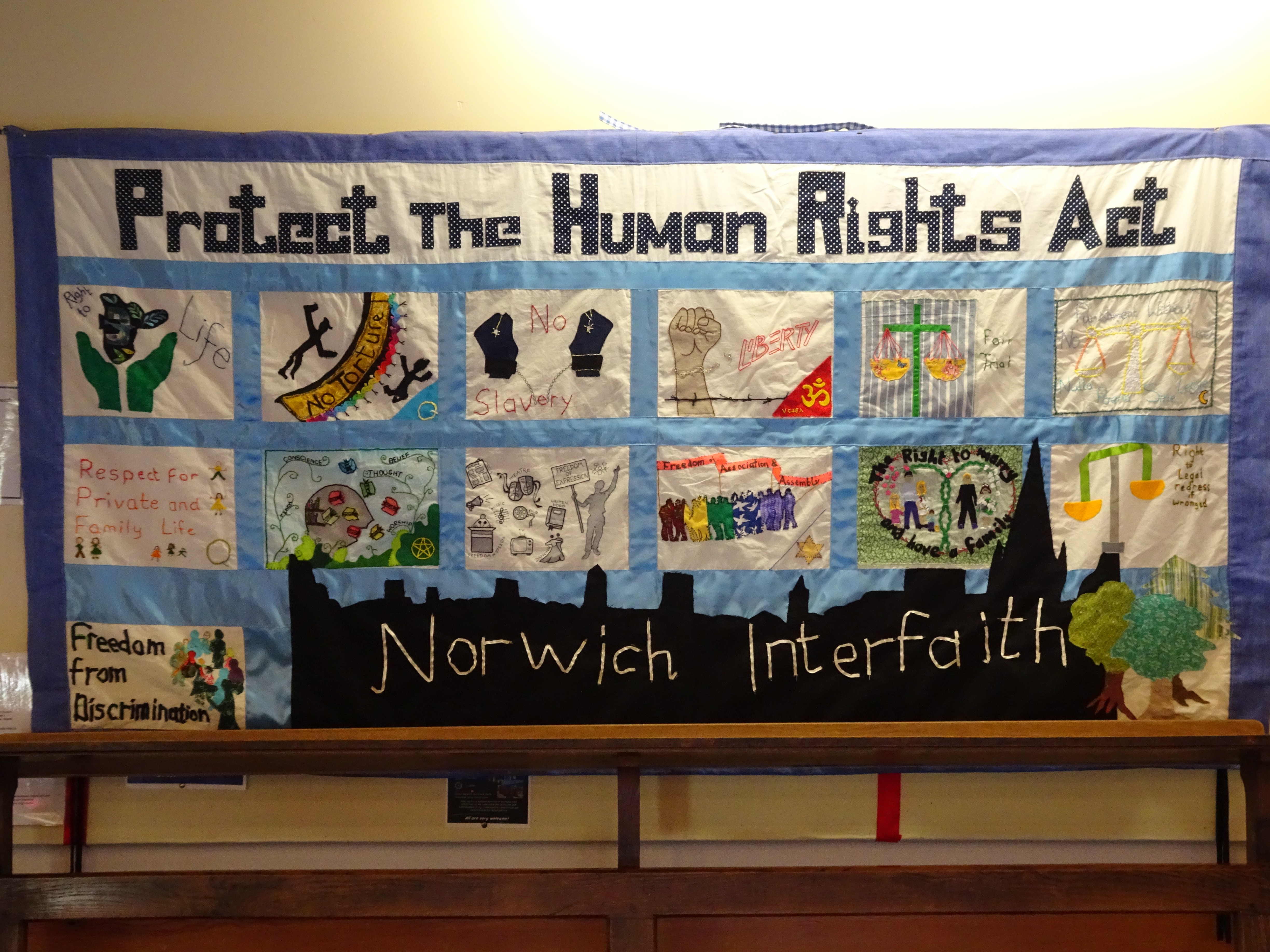
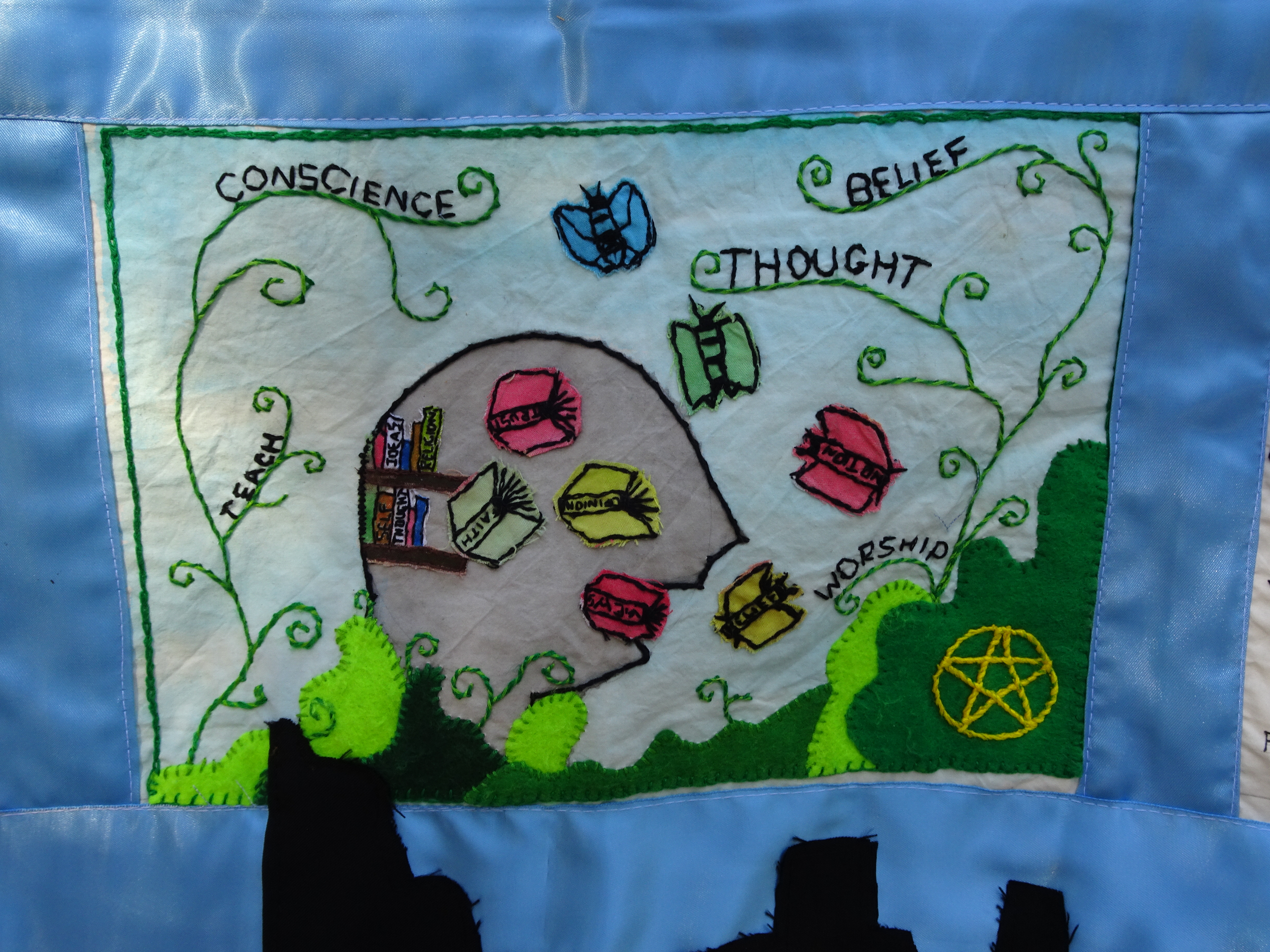
The inter-faith Human Rights quilt has now been unveiled in public! It was shown at the annual Norwich Peace Camp in the Octagon Room of St Peter Mancroft church in Norwich (and on the railings) on Monday 21st September (UN International Day of Peace). It includes the panel made by Debz Thompson, as a Pagan representative, featuring Article 9 of the European Convention on Human Rights (incorporated by the UK Human Rights Act 1998), which protects the fundamental right to freedom of thought, conscience and religion. It covers the right to change religion/belief, and to manifest beliefs through worship, teaching, practice and observance, either alone or in community with others. For more on the making of the quilt and the panel, see the archive.
Gefjon by Vix Valentine
Val Thomas writes…
The fourth Goddess whom we will welcome to our Twelfth Night ritual is Gefjon (sometimes spelled Gefiun). When she is introduced in the list of goddesses, in Snorri Sturluson’s Prose Edda, we are told that she is a virgin and attended by all who die as virgins. However, it should be remembered that Snorri was writing from a Christian perspective and her stories indicate that the use of the term ‘virgin’ is not entirely straightforward.
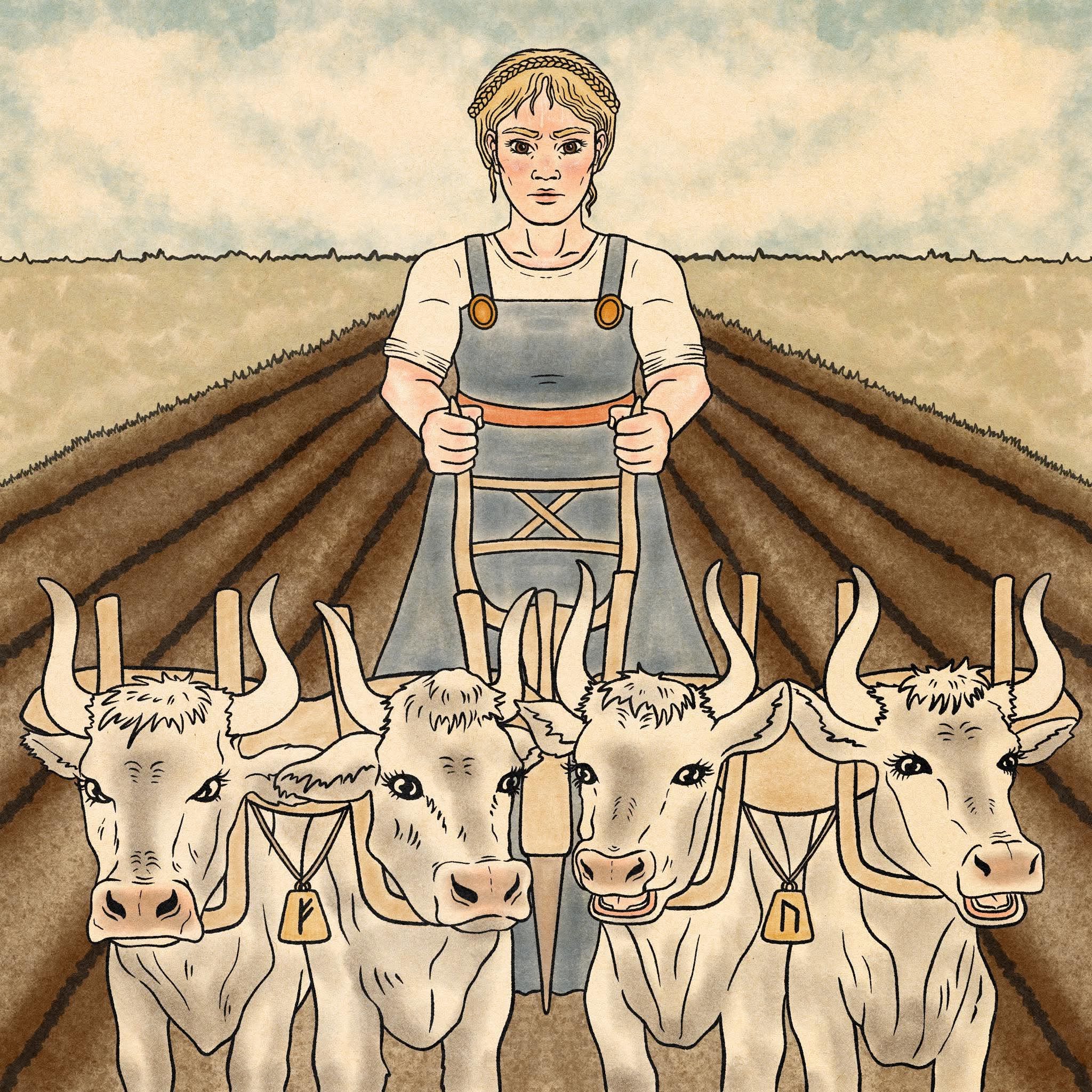
Rev. Máire Durkan, in Frigg’s Twelvefold Flame, describes Gefjon as a "cultivator of abundance, guardian of autonomy"and as a "carver of kingdoms". In one story, Gefjon travels to Sweden, looking for land for Odin. Disguised as a beautiful, wandering storyteller, she visits King Gylfi, who asks her what she would require in exchange for ‘entertaining him’. Gefjon requests as much land as she can plough in a day and a night and, underestimating her, King Gylfi agrees to her terms. However, Gefjon travels to Jotunheim, the realm of the giants, one of whom fathers four sons with her. They were strong and embodied the ancient forces of fire and ice and the power within the Earth. She turned them into huge oxen and, with them, ploughed out a vast tract of land which she set into the sea and which became the island of Zealand, now the part of Denmark where Copenhagen is located. The crater in the land from which Gefjon carved out her island filled with water and became the lake now known as Mälaren. In Copenhagen, in Nordre Toldbod, there is a beautiful fountain which includes a sculpture of Gefjon and her sons, made by a Danish artist, Anders Bundgaard. The fountain was switched on for the first time in 1908.
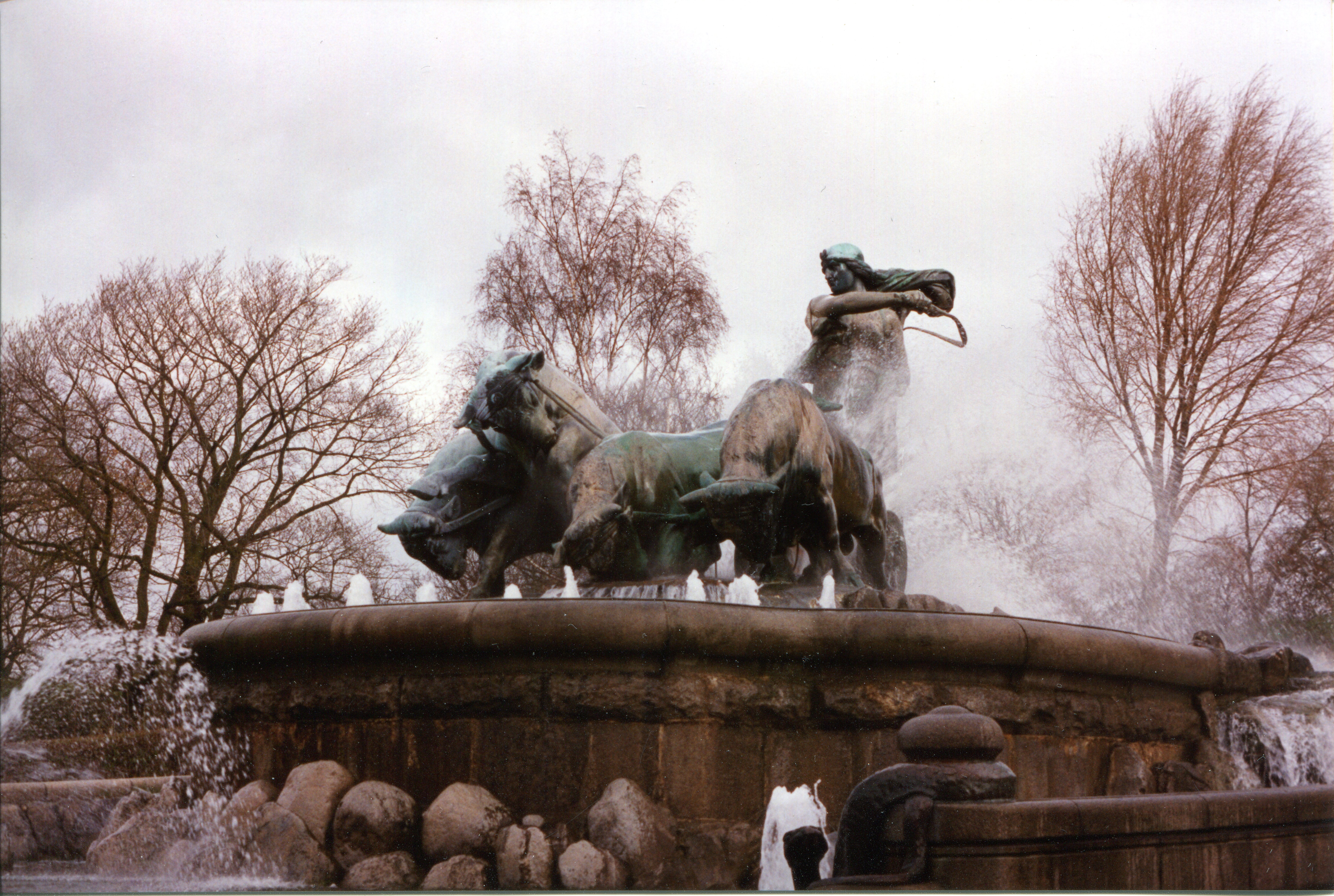
The Gefjon Fountain in Copenhagen, picture by Chris Wood
In Lokasenna, in The Poetic Edda, Loki (who is arguing with everyone) accuses Gefjon of having had her heart seduced by a white boy, possibly Heimdall. He gave her a jewel and she laid her thigh over him. Odin defends Gefjon and tells Loki that he is crazy to make an enemy of her because she knows the fates of all men as clearly as he, the All-father, does himself.
Sheena McGrath (1997) in Asyniur: Women’s Mysteries in the Northern Tradition, suggests that Gefjon is a goddess of sovereignty since she gave a kingdom to Odin and married his son Skjold or Scyld who founded the dynasty of the Scyldings. She produced a line of rulers and gave them something to rule over.
Various runes have been associated with Gefjon. Gifu is an obvious choice because her name means a giver of gifts, but Fehu is also relevant as it is associated with wealth and cattle. Uruz is a rune of great power and strength and, while it is usually considered to symbolise the horns of the aurochs, it speaks to me also of the muscular force of the oxen and the might of Gefjon herself.
Eir by Alice Kerridge-Crick
Val Thomas writes…
Our third goddess for Twelfth Night is the great healer, Eir.
In the Gylfaginning, in Snorri Sturluson’s Edda, High (possibly Odin) places Eir in the third position amongst the Ásynjur, following Frigg and Saga, and says, simply, that she is a very good physician, while in Skáldskaparmál, she is listed amongst the Valkyries, perhaps because she also plays a role in treating the wounded on the battlefield. In the The Poetic Edda, in Fjölsvinnsmál, the hero, Svipdagr, travels up a mountain named Lyfjaberg in order to woo the goddess, Menglöð, whose female attendants include Eir. The name Lyfjaberg was translated by Henry Adams Bellows, in 1923, as ‘Healing Mountain’, and those who dwell there may shelter and save people who make offerings to them, according to Hilda Ellis Davidson (1998) in Roles of the Northern Goddesses.
In Larrington’s 2014 translation of The Poetic Edda, any pain-ridden woman who manages to climb up the mountain becomes well. This suggests to me that a person will only be healed if they first make the effort to do what is needed. Eir may help but you have to struggle to get to her first. Perhaps addressing our issues, be they concerned with diet, addictions, self-sabotage or whatever else is exacerbating our ill health, is the offering required to appeal to Eir for healing. We must take action first. So, we need to take our herbs, go for a walk, give up smoking or consult a doctor. She isn’t just going to wave a magic wand over us.
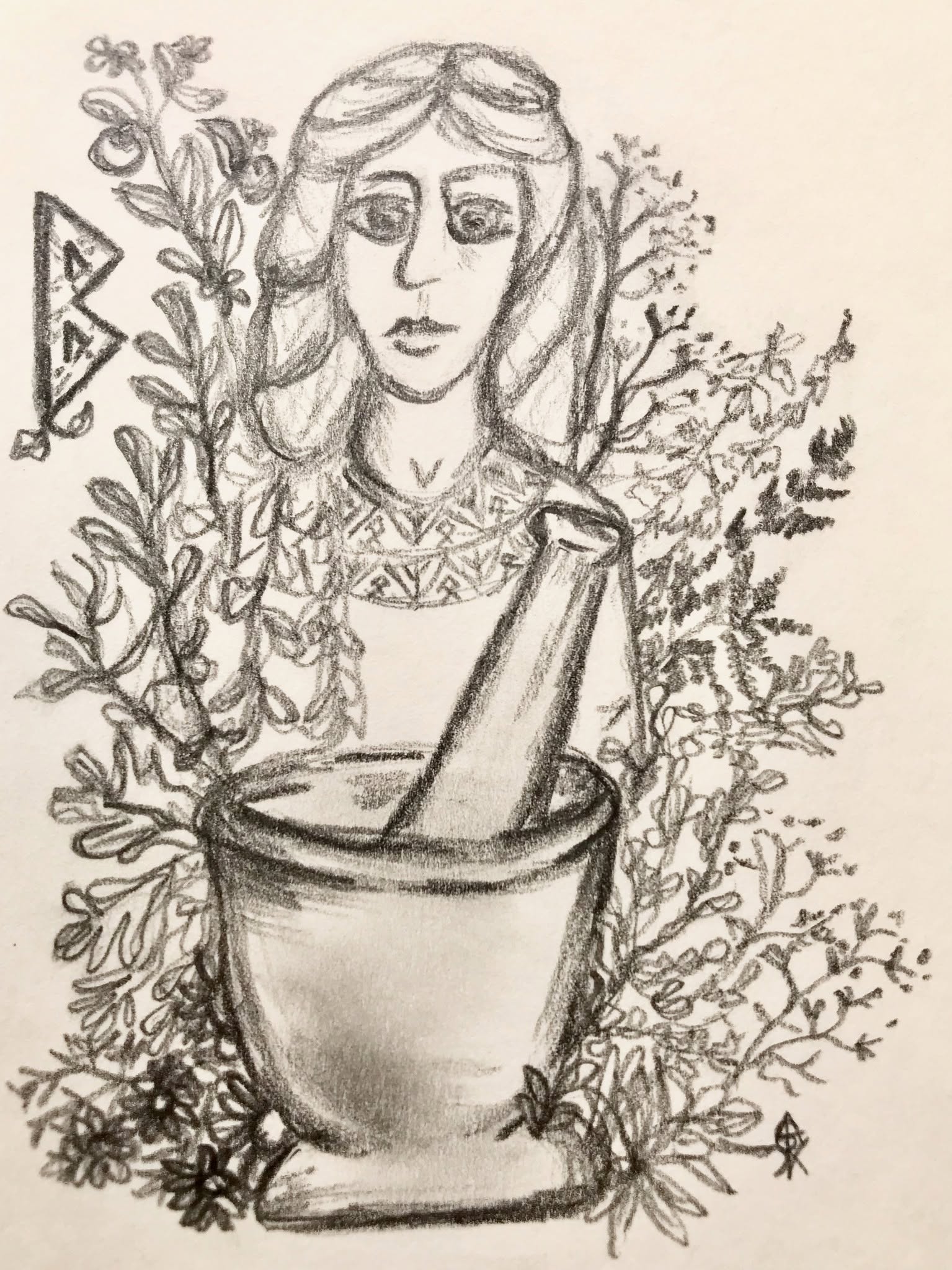
The Rev. Máire Durkan points out that there is an Old Norse word, eir, which can mean help, mercy, peace or clemency, and she sees Lyfjaberg as a hill of healing where herbs are used to treat ailments and wounds and where our spirits are gently mended. In Frigg’s Twelvefold Flame, Durkan provides a useful visualisation, involving ascending Lyfjaberg and finding Eir in a cottage, grinding herbs in a pestle and mortar, and asking for her assistance, which is a good way to begin to develop a relationship with this important Ásynja.
Both Freya Aswynn and Rev. Máire Durkan associate the same runes with Eir: Berkano, for its sense of renewal and nurturing growth, Laguz for its emotional and physical cleansing, and Sowulo for vitality and energy.
Thus, Eir is a goddess for each one of us, whether we have healing roles within our community or whether we ourselves are seeking healing for any kind of dis-ease. After all, none of us is immune to illness and malaise in the face of the stresses and ravages of our lives upon this Earth.
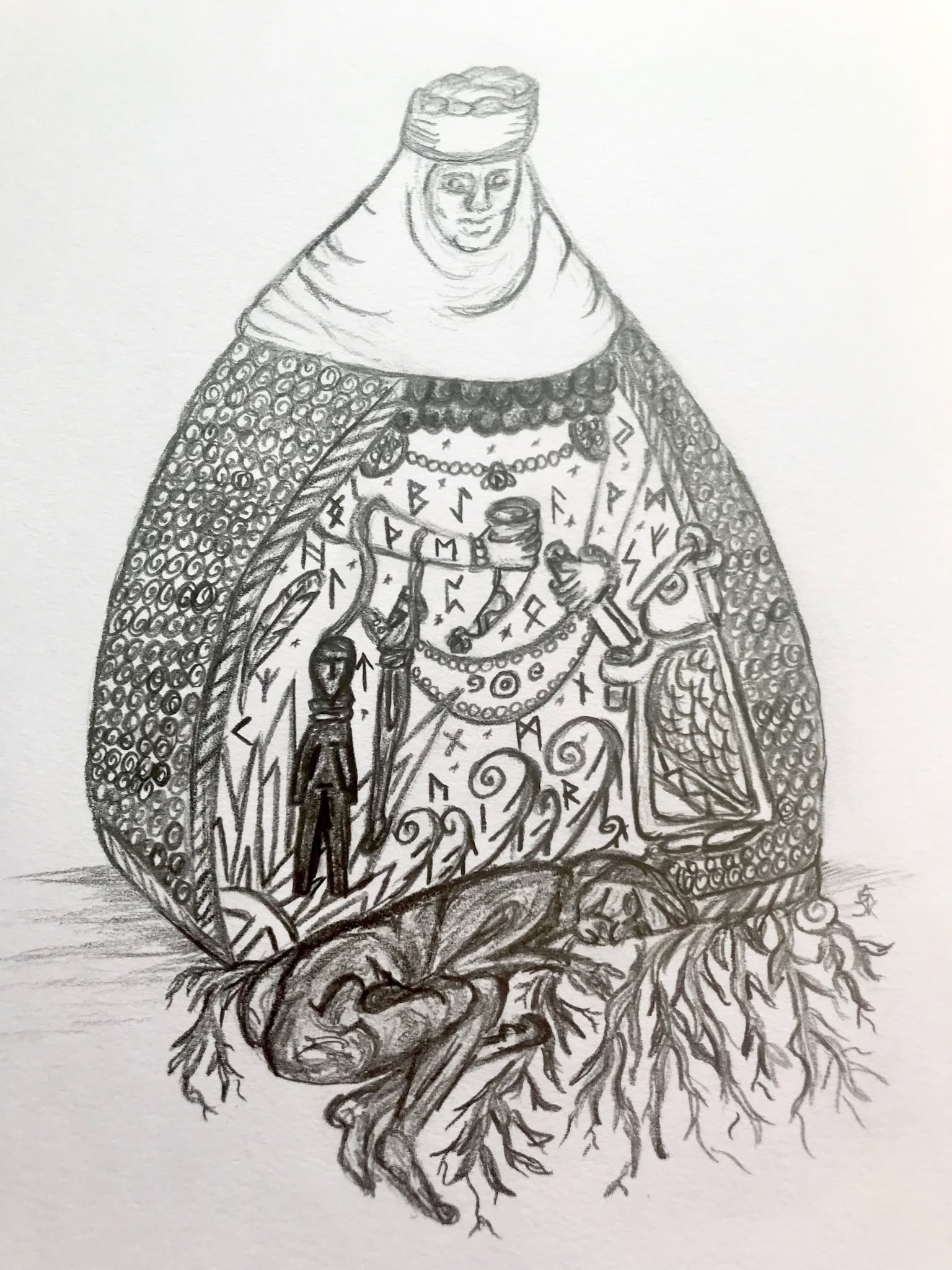
Saga by Alice Kerridge-Crick
Val Thomas writes…
Welcome to the second week of our exploration of Frigg and the Ásyniur associated with her, in preparation for our 12th Night Ritual in January 2027. Today’s goddess is Saga.
In Gylfaginning, Saga is listed as second to Frigg amongst the Asyniur and we are given the name of her dwelling place as Sokkvabekk (meaning ‘sunken bench’ or possibly ‘treasure bank’), which is said to be very large. Saga is also listed in Skáldskaparmál. However, it is from Grimnir’s sayings that we learn how cool waves resound over Sokkvabekk and that Saga and Odin drink there every day from golden cups. There is also a headland named Saga which is mentioned in the first poem of Helgi Hundingsbane.
Some commentators consider Saga to be another name for Frigg, including Freya Aswynn, who seems to equate Frigg’s fenland home, Fensalir, with Saga’s Sokkvabekk, suggesting that Frigg has foreknowledge of everything while Saga, living by the stream of time and all that has happened, represents Frigg’s memories. Personally, I prefer to see her as a goddess in her own right, because it is possible to be aware of her as a powerful presence with her own distinct characteristics and magical aspects. Her name means ‘story’ and is connected to the Old Norse word seyja, which means to say or to tell and, as Rev. Máire Durkan points out, in Frigg’s Twelvefold Flame, Saga meets Odin as his equal.
Saga brings blessings to those of us who are storytellers, writers, chroniclers, historians, archivists and keepers of memory in whatever form, the latter role applying to all of us as we honour our ancestors and share tales about them. Stories are important and Saga can help us not only to remember them but to speak out and allow what they teach us to inform our lives in the present.
Associating runes with a deity is very personal, but for me, one of Saga’s important runes is Laguz, because she dwells by the lake and is ever close to the waters of memory. Setting out upon them can prove a perilous and emotional experience, albeit a necessary one at times. I would also consider Ansuz to be a rune which can help us draw upon Saga’s attributes because it represents the mouth and communication, the transmission of information and memories. Othala too, as a rune of ancestral inheritance, be that physical land, our qualities, our genetics or our family stories, is also one to work with in connection with Saga.
So much of our work at the Moot is informed by and hopefully blessed by this beautiful goddess who, if we open ourselves to her qualities, may hold out a horn of golden mead to inspire us in our work. Our Twelfth Night Ritual is itself an act of sacred storytelling and we ask Saga to bless and guide our preparations for it and the performance of the rite itself.
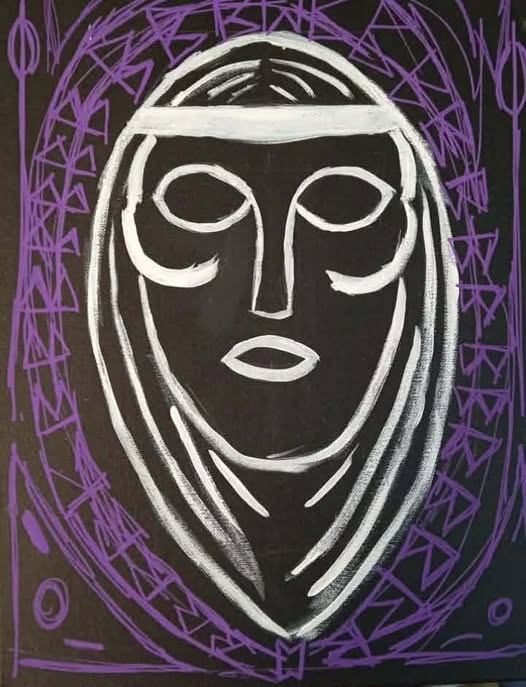
Frigg by Bestla Lavender
Val Thomas writes…
We begin our exploration of the deities we will be working with at 12th Night (see below) with Frigg, who is regarded by many as the foremost of the Norse goddesses, a Queen of Heaven. When Gangleri, in the Gylfaginning, asks, "Who are the Asyniur?" the answer is:
The highest is Frigg. She has a dwelling called Fensalir and it is very splendid.
There follows then a list of all her handmaidens: Saga, Eir, Gefjon, Fulla, Sjofn, Lofn, Var, Vör, Syn, Hlin, Snotra and Gna, each of whom we will be discussing in the coming weeks.
Rev. Máire Durkan, in Frigg’s Twelvefold Flame, traces the name Frigg to root words meaning peace, love, freedom, family, friendship and beauty, and all of these qualities are shown in the stories which feature her.
Frigg knows the Fates of all people but is renowned for her secrecy and, although she is a seeress, she does not make prophesies. Her husband is Odin and her son is Baldur and, in one of the major stories featuring Frigg, she is unable to avert the fate of her son, even though she endeavours to so, but nevertheless has to take on the mantle of grieving mother.
People often like to link Norse deities to particular runes. Freya Aswynn, in Northern Mysteries and Magic: Runes, Gods and Feminine Powers, says that Frigg’s rune is Perthro because she is a goddess governing birth and fate and the outpouring of creativity, but also Berkana, which is breast-shaped, suggesting her nurturing aspect.
Frigg is much beloved by many of us at the Moot as she is a patroness of spinning – taking raw material and producing the magical thread which can be used for weaving. Freya Aswynn, suggests that it is Frigg who is "in charge of the prima materia" and spins the substance from which the Norns weave our fate. Her symbols are spinning tools, the drop spindle and the distaff. Indeed, the constellation, Orion’s Belt is sometimes called Frigg’s Distaff.
Frigg is also a favourite goddess in Norfolk, because the name of her hall, Fensalir, literally means ‘marsh hall’, and we feel her presence very powerfully in the wetter areas of the county, particularly in Broadland. I would definitely recommend a boat trip on the Broads as a way of enhancing your connection with her and Autumn is a particularly good time for this. You will probably also see a heron standing still and silent in the reeds, as this is one of her special birds.
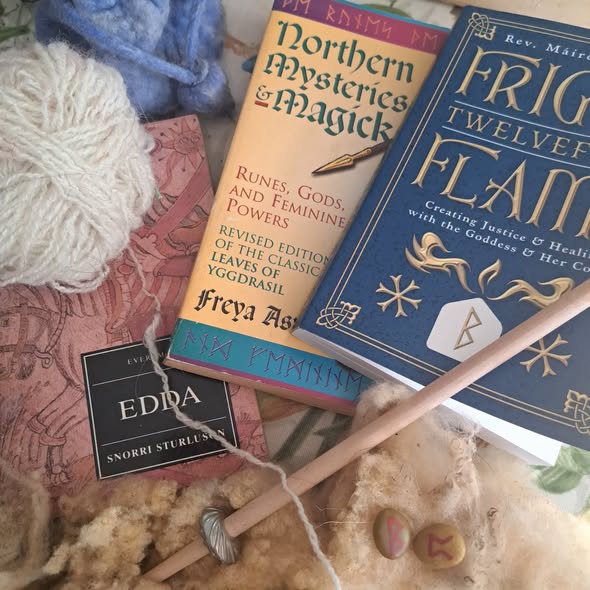
Picture by Val Thomas
Val Thomas writes…
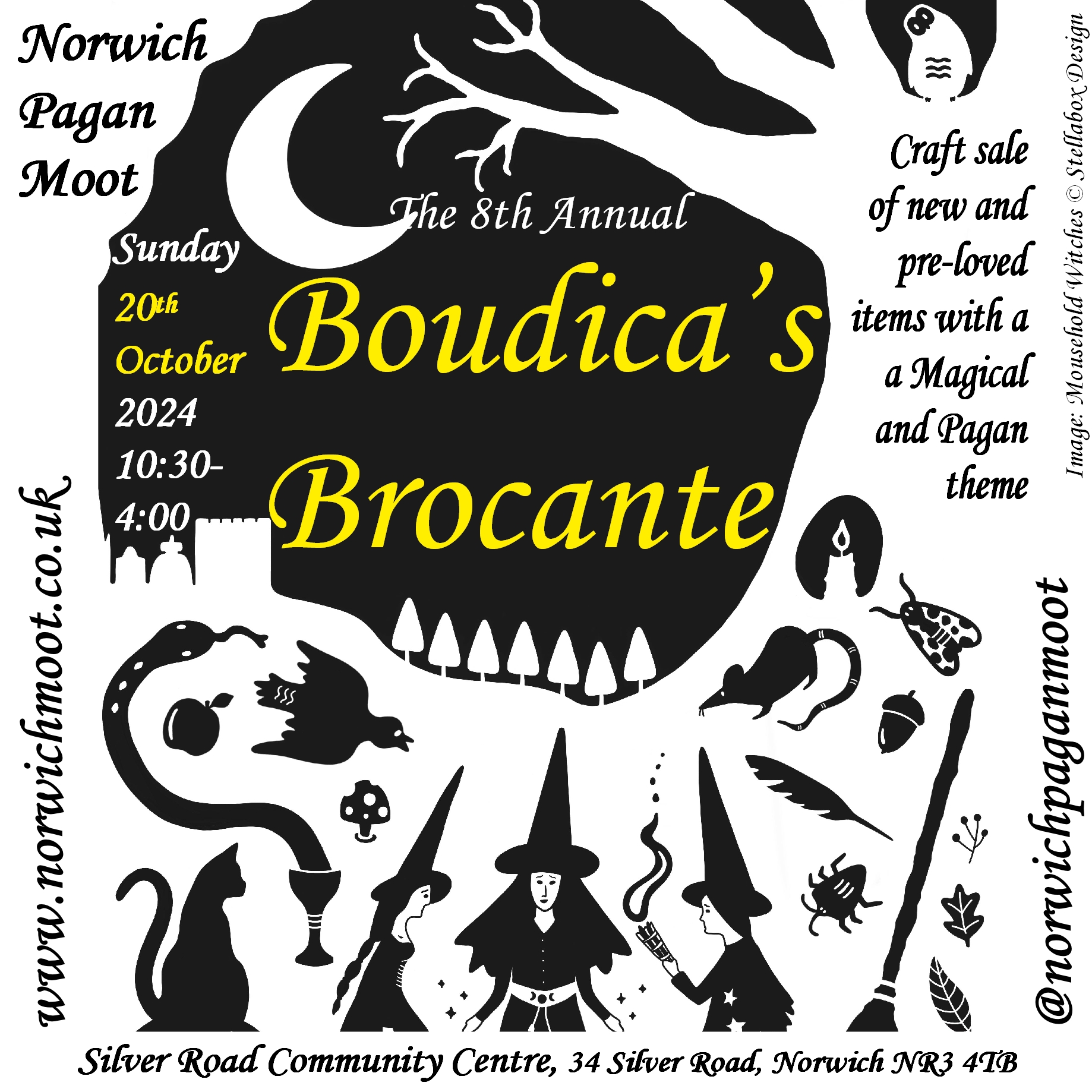
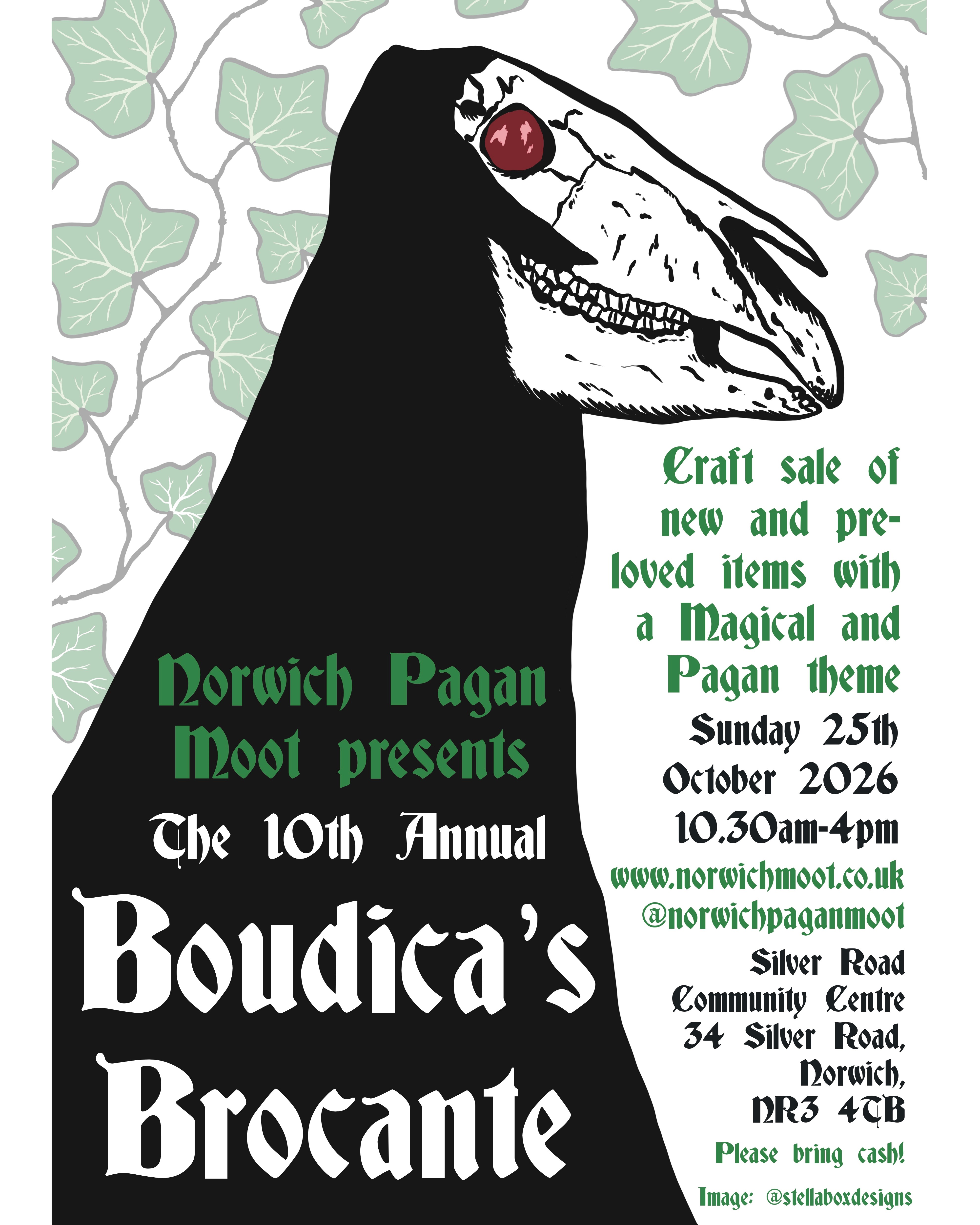
Now the season is changing once again our thoughts turn to our Autumn activities. We have a lovely programme of events for you and, of course, our annual Boudica's Brocante which celebrates its 10th birthday this year! Put the date in your diary and keep an eye on the Brocante page for information about our lovely stallholders and what they have to offer this year. We'll also be looking for some helpers too, particularly for the kitchen.
Another exciting announcement is that our 12th Night Ritual for 2027 will be held on Saturday 9th January in the usual place on Mousehold Heath. (It's a bit late this time but the previous Saturday we felt was a bit too early.) The ritual will be written and organised by the wonderful Bestla Lavender with help from Alice Crick and Vix Valentine. The theme is Frigg and her handmaidens. Some of you will remember the wonderful series of workshops which Alice led on this topic three years ago, but just in case you weren't able to attend those, we will be posting information about all these deities during the weeks leading up to Yule!
Chris Wood writes…
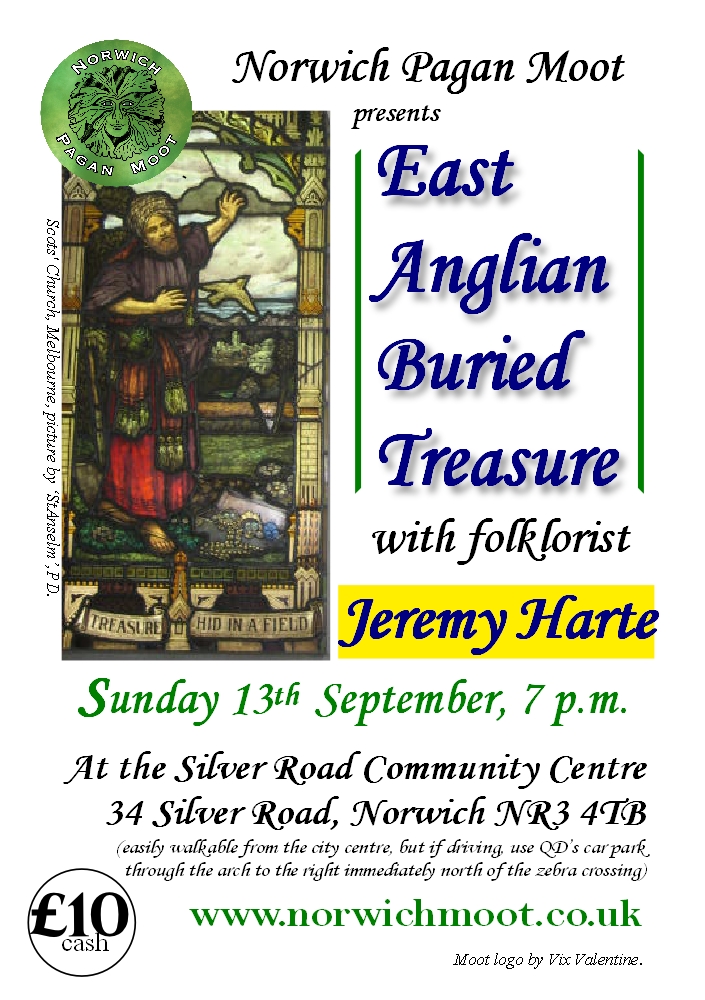
And don't forget our very special talk on Sunday 13th September: Jeremy Harte, author and folklorist, will be telling us all about East Anglian Buried Treasure! There's more on the Events page. Admission is a bit higher for this one, as he has a distance to come and will be staying the night, but it is well worth it!
|
Chris Wood |
General organiser; Coffee Moot; events; web-site; external and media ambassador; inter-faith; Ickeny Collection; speaker; guided walks; Faceboook admin. |
01603 667 314 |
|
Alice Kerridge-Crick |
On sabbatical. |
|
|
Val Thomas |
Talking to people; events; author; speaker; herbalist; herb walks; Facebook admin. |
01603 667 314 |
